Friday, September 28, 2012
Game vs. Art
A game is interactive and allows for movement, players, rules, and strategy. A game may very well have a style and purpose to it. A game is relative to new media and how creativity can be taken to a different level. The games we played in class included artistic means, such as the use of photography, perspective, and color. A game can be played by one person or multiples, just like art can be created by one person or in a group. There is also a history behind, both art and games. Art and games have evolved over time, yet they are still played, viewed, and discussed. Both games and art can also be documented and planned out.
However, a game is also very different from art that we may see or create for a gallery space. For example, an artist can create a video, drawing, or a sculpture. It already has an essential purpose and meaning created by the artist and is interpreted differently among viewers. The art piece remains the same, unless changes are made to it in the future. These forms of art are not very interactive or are influenced by viewers after they have already been created, unless it is an interactive installation. When I say influence, I mean manipulated or altered in some way. A painting is concrete and within reach. A game can be replayed and have different outcomes and possibilities. Art has an aesthetic quality to it and can often be defined by one medium or mixed media, as well. Art and games have similar qualities, but can also be viewed in your own way.

Friday, September 21, 2012
I Spy, Picture Perfect Game
Players:
-Two people
on each team
-There is one
picture holder
Idea:
Teams will
agree on location or boundaries at Oakland to play at (a building, outdoor
court -being specific, OU Center, Recreation Center). The picture holder will take pictures,
sending them to each team. In this case,
Leah will be the first picture holder.
Objective:
Teams want to
try and figure out what the object is that is being captured and sent to each
team. When the teams figure out what the
object is they will get points. There
will be at least 5 pictures taken by the picture holder, varying on
difficulty.
Rules:
Picture
holder has to impose a challenge to the teams; paying attention to composition
and the type of shot (close up, medium shot, etc.)
Teams will
have three tries to guess the object in the picture. If the team guesses it correctly on the first
try they will get 5 pts, second try is 2 pts, and third try is 1 pt. If they do not guess it correctly there will
be no points gained. The team with the
most points after five or more pictures will be safe. The team with the lowest point will have to
switch out one of the team members and become the picture holder. The person that was already the picture
holder will then join the other team member with the lowest amount of points.
Game can keep
going until time is up…
Goal:
-At least 5
pictures taken per picture holder
-Avoid being
the picture holder, based on points
Tuesday, September 18, 2012
Exquisite Corpse Game
Time period: 1930's, or it was argued that it started around 1918.
One of the creators is Andre Breton. There are pictures and example that are easily accessible on online.
"Surrealist techniques exploiting the mystique of accident was a kind of collective collage of words or image..."
It was based on an old parlor game where several people played. A player would write a phrase on a sheet of paper, covering part of their phrase. The next player would then finish their phrase, creating a new one. Not knowing what it was going to say was the fun part of the game. This game was also adapted into drawing. A player would fold up a piece of paper into two or three sections and create a drawing. It could be anything, or a general person/creature. The fun is to not see the other sections until the art is complete.
This game is still played, today. I remember playing it in elementary, myself. This is something to keep people entertained for hours.
One of the creators is Andre Breton. There are pictures and example that are easily accessible on online.
"Surrealist techniques exploiting the mystique of accident was a kind of collective collage of words or image..."
It was based on an old parlor game where several people played. A player would write a phrase on a sheet of paper, covering part of their phrase. The next player would then finish their phrase, creating a new one. Not knowing what it was going to say was the fun part of the game. This game was also adapted into drawing. A player would fold up a piece of paper into two or three sections and create a drawing. It could be anything, or a general person/creature. The fun is to not see the other sections until the art is complete.
This game is still played, today. I remember playing it in elementary, myself. This is something to keep people entertained for hours.
Monday, September 10, 2012
Show and Tell
My favorite work of art relative to New Media is a video I created called Relentless Mind, Calm Body. The video is roughly 4 minutes and 6 seconds long. It was completed and uploaded late 2011. I developed my ideas for this work in my Video Art I class, taught by Vagner Whitehead. This is a work inspired by my deepest, most personal thoughts. I represent myself and my insecurities through voicing my conflicted memories. "The mind is conflicted with memories and how one should perceive them. Demonstrated through painting the body with red paint (memories) and washing them away; soaking in them. Memories are seen through experiences, following me in the water." -My Vimeo page
http://vimeo.com/33051386
I am most proud of this work because this is when I realized that I had developed a style. I felt that this video helps people see me in a different light. I wanted to bring emotion and visual stimulation to the viewers.
http://vimeo.com/33051386
I am most proud of this work because this is when I realized that I had developed a style. I felt that this video helps people see me in a different light. I wanted to bring emotion and visual stimulation to the viewers.
Tuesday, April 10, 2012
Critique: In Progress
Through observing critiques and getting feedback on my work, I have a better idea of how I am going to execute my ideas. Through hearing what my classmates and professor had to say, I was able to figure out a way to make my transitioning of my statue figure more obvious by incorporating some sound effects that were suggested in class. Critique pushed me to consider how I was going to make the transformation fit the aesthetics of the overall video. I went back and looked at the filters I was using and adjusted them to make it less shaky for the viewers, but also added other filters or effects to make certain colors pop.
I decided to add to the imagery or changed some things around, visually, in order to make my work an effective multichannel piece. I would have liked to have kept the single channel with multiple screens because I liked the look of it, but it wouldn’t have met the requirements. Therefore, I am still considering using two desktops or may experiment with the projectors, depending on how I like the feeling of the large or smaller scale. I feel that I like the way it looks on monitors because of the detail and color is better.
Overall, I was satisfied with the footage I had and the direction I went with. I want to keep the text and old feel of the myth. Critique did not change my direction, but helped me better meet the requirements and push my work to be more successful.
Saturday, March 31, 2012
Ann Arbor Film Festival


The first thing I went to see was Phil Solomon’s American Falls. There were three large screens that were projecting his work. Before reading about it, or catching what the title was, I watched it to see if I could figure what it was about. I thought the piece was really interesting with bits and pictures of history, deformed and blotchy. The integration of images and words was great. It made me think of politics and how “hazy” independence, rights, and equality are, today. The way the images looked and how the sound was intense at times made me think of corruption or how history and what the country fought for has been tossed into the “muck.”
I also went through the exhibition where you had to take a mirror in with you and look at it at eye level, as you walked through it. It made me feel as if I was walking through this different environment with images projected on the ceiling, which were now reflecting at my feet. It was a creative way to play with perception and our idea of space.
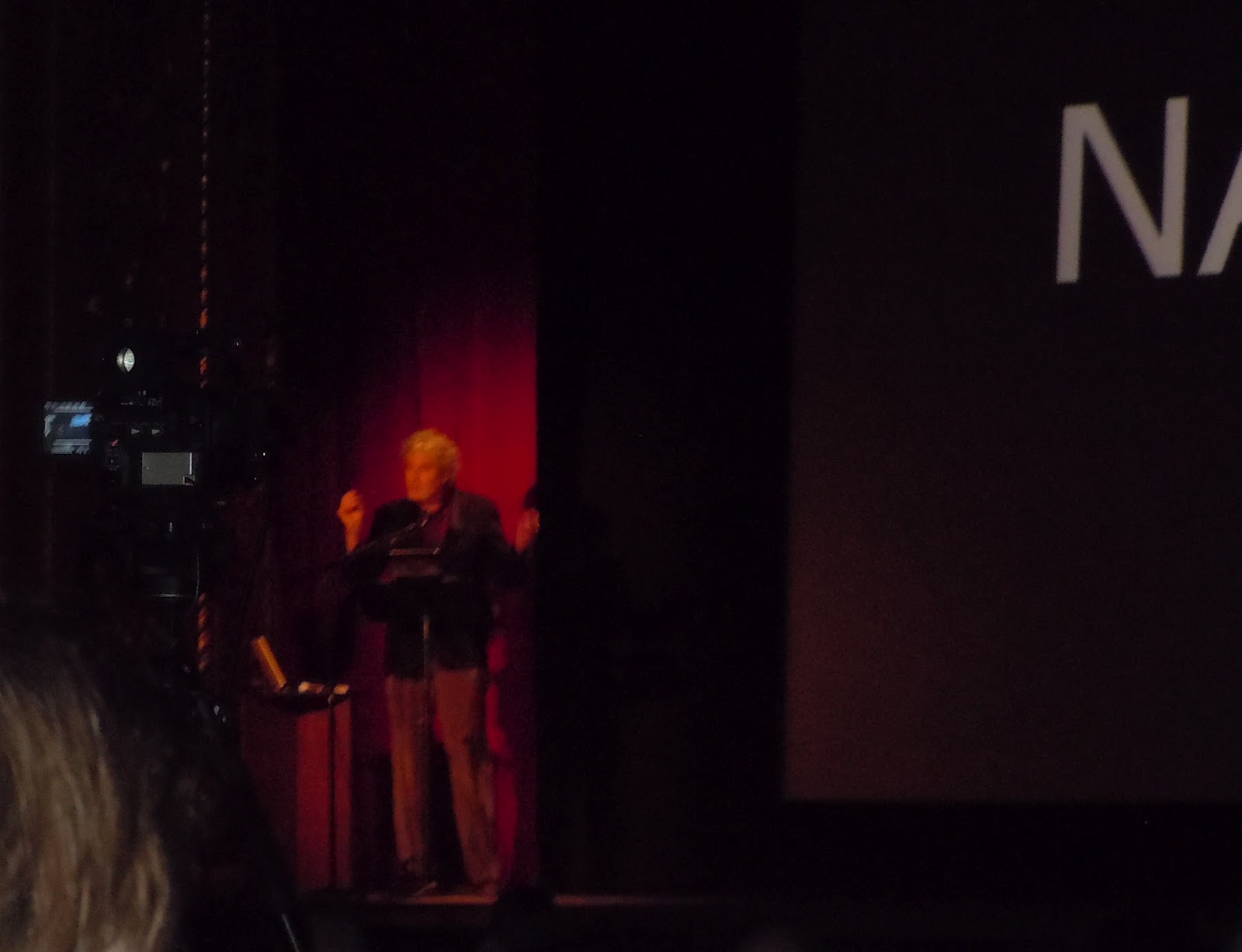
After, I went to the Michigan Theater and listened to Craig Baldwin’s speech. His vision is collage-based and he focused a lot on using found footage, making it your own. He looked at film as a form of rebellion, creating your own identity through film. He loves video and thinks using real film to create work is still relative to creativity, and it is how he wishes to continue his work. He mentions the birth of film from the Kuleshov effect and Eisenstein montage (time of Soviet Union), which is something I have learned in my cinema class this semester, so to me it was relevant. Baldwin stressed how music, Avan Garde, Dada, and culture has influenced him, as well as, filmmakers.
Overall, I thought it was great to see something new because I have never heard of the Ann Arbor Film Festival before. I would like to go again next year.
Monday, March 26, 2012
Gerry Fialka- speaker/workshop
I thought that the discussions and thought processes presented by our speaker last week was very interesting and uplifting. It made me feel that my opinions, judgments, and thoughts are just as great and accurate as anyone's. This is because he is accurate in saying we have all formed into this norm or idea of accepting something for what it is. There is room for other "theories" and ideas, and ways of completing our everyday tasks. There are creative ways to explore life and get involved in thinking out of the box.
Often I was confused by the topics we were covering; however, it was fun to be spontaneous and talk about topics that are not always thought about at school, work, and home. I agree that is important to combine work and home because you should love what you do. You should always be critically thinking and observing things around you, connecting your home life and work life. However, I feel that my work life and home life are so different at the moment that I do not like combining the two. Emotions and stress, to me, are often brought home from work and school. Instead, I want my ideas and thought processes to follow me.
I felt that when he asked questions and told us to give one word answers, that my answers were always thought-provoking. I am unsure this is because I am creative, or because I like coming up with answers that provoke others. I like to trick or impress people with ideas because often ideas are difficult to come across when we have to think quickly. I feel it's sometimes easier to think of something when you have less pressure. For example, thinking of a video topic may seem difficult when you are given certain guidelines and are under pressure to meet the standards.
Fialka made it clear that thinking for yourself is very important and that not even teachers, scientists, or government knows the answers to everything, yet has an "explanation" for everything. Listening to Fialka's comments and points of view almost upset me because to become an art teacher I have to follow strict courses and procedures. Yet, he stressed that everything we see and do isn't always the correct thing to do, but is accepted as a norm.
Often I was confused by the topics we were covering; however, it was fun to be spontaneous and talk about topics that are not always thought about at school, work, and home. I agree that is important to combine work and home because you should love what you do. You should always be critically thinking and observing things around you, connecting your home life and work life. However, I feel that my work life and home life are so different at the moment that I do not like combining the two. Emotions and stress, to me, are often brought home from work and school. Instead, I want my ideas and thought processes to follow me.
I felt that when he asked questions and told us to give one word answers, that my answers were always thought-provoking. I am unsure this is because I am creative, or because I like coming up with answers that provoke others. I like to trick or impress people with ideas because often ideas are difficult to come across when we have to think quickly. I feel it's sometimes easier to think of something when you have less pressure. For example, thinking of a video topic may seem difficult when you are given certain guidelines and are under pressure to meet the standards.
Fialka made it clear that thinking for yourself is very important and that not even teachers, scientists, or government knows the answers to everything, yet has an "explanation" for everything. Listening to Fialka's comments and points of view almost upset me because to become an art teacher I have to follow strict courses and procedures. Yet, he stressed that everything we see and do isn't always the correct thing to do, but is accepted as a norm.
Subscribe to:
Posts (Atom)